

Considerations for a Commercial Roof in North Carolina Business
Here in North Carolina, hurricanes, severe weather, and subsequent water damage are major threats to the roofs of businesses and homes. It only takes a wind speed of 75 mph to cause damage to a commercial roof. Considering hurricane Ian had wind speeds reaching up to 155 mph, North Carolina businesses need to ensure their facilities are well-equipped to ride out any storm.
Heat is also a factor for any North Carolina business, as this can directly result in higher energy bill costs. This can be remedied by using an adequate roof which can significantly reduce heat absorption during the summer months.
Which Commercial Roofing System is Best in North Carolina?
Spray Polyurethane Foam (SPF)
Spray Polyurethane Foam (SPF) roofs are simply the most cost-effective, strong, and leak-resistant roofing material a business can have. SPF has been used since the early 1960s for commercial/industrial/residential facilities and has remained a popular choice for a good reason!
Why are SPF commercial roofs so popular?
- Heat resistance
- Installed SPF roofs are a “brilliant white” color, which has been shown to reduce heat absorption by 85%.
- Provides seamless insulation to further protect the interior temperature of a facility.
- Reinforces structural integrity of a roof
- Resistant to storm-related impact
- Wind
- Rain
- Hail
- Seamless and conforms to any shape to ensure no leaks/water damage.
- Resistant to storm-related impact
- Quicker Installation
- Less labor time
- Conklin roofs are available with 10-18 year warranties
- Pro Tip: Extend your warranty by getting maintenance/recoating when nearing the expiration date.
- This will increase the life of your roof for another 10 years!
- Pro Tip: Extend your warranty by getting maintenance/recoating when nearing the expiration date.

Single Ply (TPO/PVC)
Single Ply roofs are a great alternative to SPF, as they are heat reflective and reliable. Single Ply roofs can also be restored to become completely waterproof via the use of a highly reflective white acrylic membrane. This roofing material has also been used since the early 1960s, so you know they are built to last.
What benefits can a Single Ply commercial roof provide?
- Reduce Energy Cost
- Heat reflective due to the white acrylic membrane
- Waterproof
- When an acrylic membrane is used, Single Ply roofs can become as seamless as SPF roofs.
- Reliability
- Long service life
- Resistant to hail damage
- Prevents wind lift

Metal Roofs
Metal roofs have been used since the 1850s and are still being installed to this day. These roofs simply work and get the job done, but there is room for improvement. A consistent struggle with bare metal roofs is that they are prone to leaks at the seams.
When should I install a commercial metal roof?
- Heat protection is not a concern
- Metal is not great at reflecting heat, which could result in higher energy costs.
- Water damage is not a critical point of failure
- In the event of a leak, would the inventory/facility be at risk?
- Amplified sound from a storm is not a concern
- Metal roofs can be noisy and can amplify the sounds of rain, hail, and thunder.
How can I salvage my existing commercial metal roof?
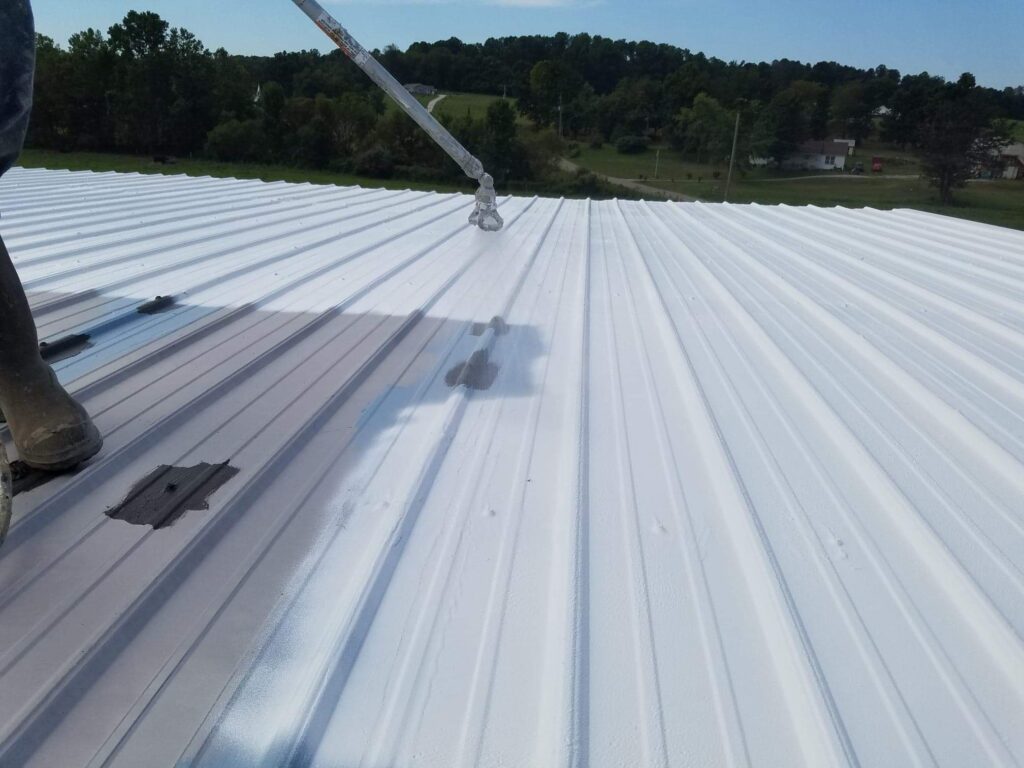
- Request your contractor to add an SPF coating
- Effectively eliminates the cons of typical metal roofs.
- See the ‘Spray Polyurethane Foam (SPF)’ section above.
- Effectively eliminates the cons of typical metal roofs.
- Request your contractor to add an Acrylic Coating
- Ensures seamless roof and prevents leaks
- Increase durability
- Resistant to hail damage
- Prevents wind lift at metal seams
- Deadens sound caused by weather and other outside interactions.
Sources:
“We Provide Superior Commercial Roofing Systems”, Melvin, accessed October 14, 2022, https://ccoatingsystems.com/
Lee, “Conklins White Roofing Systems Is The New Green”, D. Lee, accessed October 14, 2022, https://commercialwhiteroofing.com/
“Hurricanes Database”, NCSU, accessed October 14, 2022, https://products.climate.ncsu.edu/weather/hurricanes/database/?search=year&yr=2022
“Cool Roofs”, U.S. Department of Energy, accessed October 14, 2022, https://www.energy.gov/energysaver/cool-roofs